
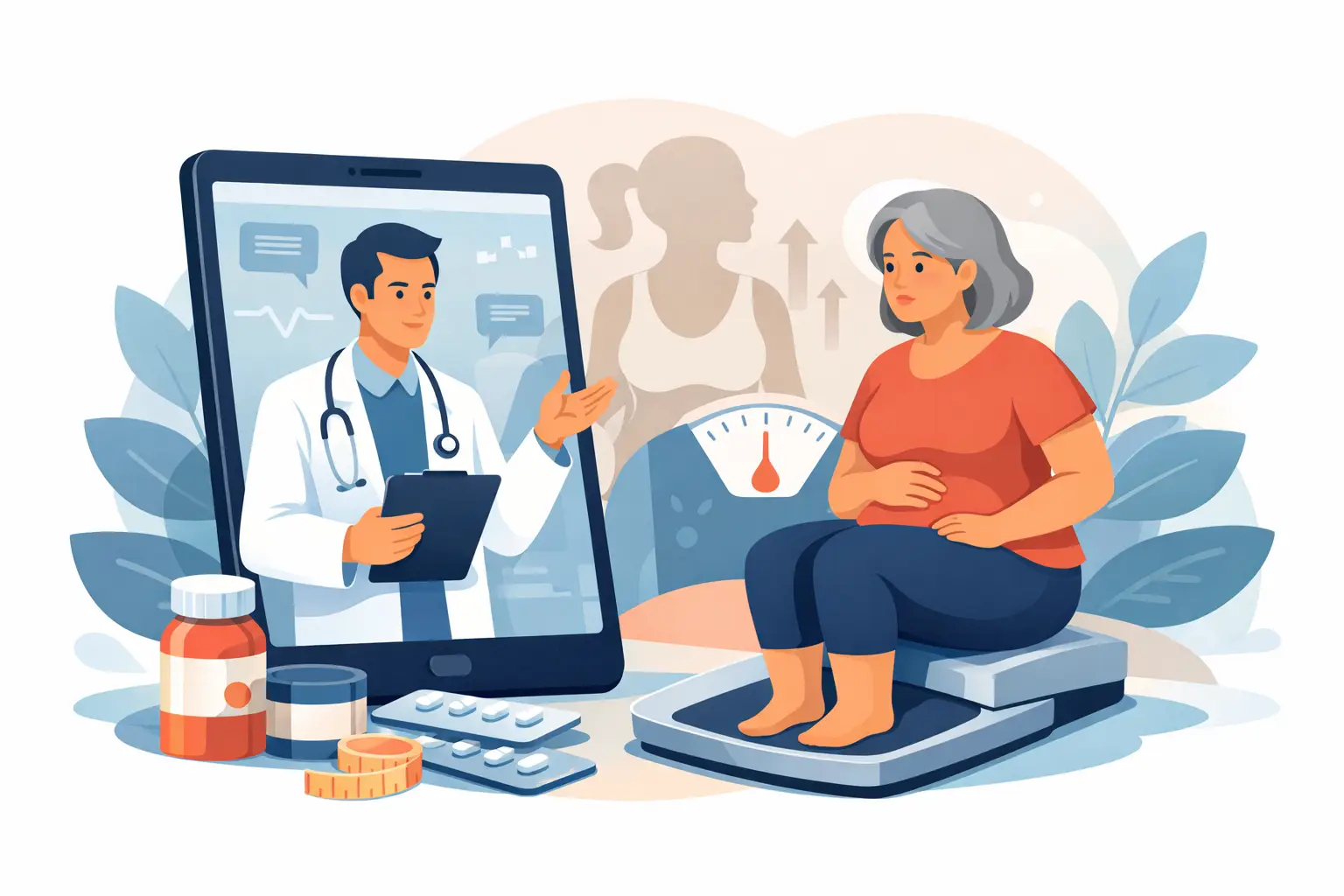
The scale moves up, your routines stay the same, and suddenly the advice that used to work feels almost insulting. For many women, that is the moment they start looking for an online doctor for menopause weight gain – not because they want a shortcut, but because they want a real medical explanation and a plan that matches what their body is doing now.
Menopause-related weight gain is not just about willpower. Hormone shifts can change fat distribution, appetite signals, insulin sensitivity, sleep quality, muscle mass, and energy. If care only focuses on eating less and moving more, it often misses the bigger picture. That is why physician-guided telemedicine can be a better fit than generic weight-loss platforms or rushed office visits.
Why menopause weight gain needs medical evaluation
Menopause does not cause weight gain in exactly the same way for every patient. Some women notice a slower metabolism and increasing abdominal fat. Others are dealing with poor sleep, rising blood sugar, fatigue, cravings, inflammation, or a combination of all of them. Stress, thyroid issues, insulin resistance, medications, and changes in exercise tolerance can all overlap with hormonal changes.
This is where a proper evaluation matters. A board-certified physician should look at the whole metabolic picture, not just your weight. That includes symptoms, personal history, family risk factors, body composition trends, and lab work when appropriate. In many cases, the question is not simply, “How do I lose weight?” It is, “What is driving the weight gain, and what else is changing under the surface?”
An online doctor can address those questions effectively when the care model is built around real clinical follow-up. Telemedicine is not automatically lower quality. In fact, for menopause and metabolic concerns, it can be more practical because treatment often depends on ongoing symptom review, lab interpretation, medication adjustments, and physician access over time.
What an online doctor for menopause weight gain should actually assess
Not all telehealth is the same. If you are considering an online doctor for menopause weight gain, the standard should be medical depth, not convenience alone.
A serious evaluation should start with your symptoms and timing. Are you in perimenopause or postmenopause? Has your sleep worsened? Are you experiencing hot flashes, mood changes, low motivation, or brain fog? Has weight shifted more to the midsection? Those details help distinguish hormonal transition from other conditions that may need separate treatment.
It should also include metabolic screening. Many midlife patients with weight gain are also dealing with insulin resistance, prediabetes, high triglycerides, fatty liver risk, or metabolic syndrome. These problems often develop gradually and can be missed when appointments are too brief or fragmented.
Hormone review may also be appropriate, but it should be handled carefully. Menopause care is not about blaming every symptom on estrogen decline, and it is not about handing out one-size-fits-all hormone treatment. The right physician weighs symptoms, risks, history, and goals before discussing whether hormone therapy, non-hormonal treatment, or targeted weight-loss support makes sense.
What treatment may include
The best treatment plan depends on what is actually driving the weight gain. That sounds obvious, but many women have already spent months or years being offered generic advice that ignores this step.
For some patients, the foundation is metabolic optimization. That may involve improving protein intake, protecting muscle mass, adjusting exercise strategy, addressing sleep disruption, and identifying patterns that worsen insulin resistance. The goal is not to hand you a trendy plan. It is to build a realistic clinical strategy that fits midlife physiology.
For others, medical weight-loss treatment may be appropriate. That can include physician-guided use of anti-obesity medications, including GLP-1 medications when clinically indicated. These treatments can be helpful, but they are not interchangeable with menopause care itself. They work best when prescribed in the context of a broader metabolic review, with monitoring for response, side effects, dosing, and longer-term planning.
Hormonal care may also play a role. If symptoms suggest a menopause-related hormonal component, your physician may discuss evaluation and treatment options based on your medical history and risk profile. For some women, symptom control can improve sleep, energy, and overall function enough to support better metabolic progress. For others, hormonal treatment is only one piece of the picture.
There is also a gut-health and inflammation component that should not be ignored. Bloating, constipation, irregular digestion, and food intolerance complaints often increase during midlife, especially when diet patterns, stress, and medications are shifting. These symptoms do not always cause weight gain directly, but they can affect adherence, comfort, and inflammation in ways that make progress harder.
Why physician continuity matters more than convenience
A common problem in online care is fragmentation. You fill out a form, receive a plan, then never speak to the same clinician again. That model may work for simple, one-time issues. It is not ideal for menopause-related weight gain, where symptoms evolve and treatment often needs adjustment.
Good telemedicine should give you physician continuity. That means one doctor who understands your labs, your symptom pattern, your medication response, and your goals over time. It also means treatment decisions are not being made by a rotating group of strangers or a call-center system.
This matters because menopause weight gain is rarely solved in a single visit. Maybe your initial labs show insulin resistance. Maybe sleep and hot flashes are making cravings worse. Maybe a medication helps appetite but needs dose adjustment. Maybe hormone symptoms improve, but body composition is still not moving the way you expected. These are the kinds of issues that require follow-up, not generic messaging.
That is one reason a physician-led model like Text2MD stands apart. The value is not just access from home. It is real doctor involvement, lab-informed decision-making, and follow-up that treats you like an ongoing patient rather than a transaction.
Signs the care is too superficial
If an online service promises fast menopause weight loss without discussing labs, metabolic risk, symptom timing, medication history, or physician oversight, that is a red flag. So is any program that pushes supplements first, treats hormone therapy like a cosmetic add-on, or prescribes weight-loss medication with little discussion of long-term management.
You should also be cautious if the process feels designed around sales rather than care. Menopause weight gain is medically complex. It deserves a plan based on clinical judgment, not a scripted funnel.
A strong online physician relationship should leave you feeling more informed, not more confused. You should understand what is being evaluated, why a treatment is or is not recommended, what success should look like, and how follow-up will work.
Is online care enough, or do you still need in-person care?
Sometimes telemedicine is enough, and sometimes it is part of the larger picture. Many menopause and weight-management concerns can be safely evaluated and managed online, especially when the model includes thorough history, lab review, medication management, and ongoing physician communication.
But there are limits. If you have symptoms that suggest another condition, need imaging or an in-person exam, or have a complicated medical history that requires hands-on assessment, a good telemedicine doctor should say so clearly. That is not a weakness. It is what responsible care looks like.
For many patients, the best online doctor for menopause weight gain is not the one who promises the quickest answer. It is the one who takes the problem seriously enough to evaluate the full hormonal and metabolic context, explain the trade-offs, and stay involved long enough to see whether the plan is actually working.
If your body has changed and the old advice has stopped working, that does not mean you failed. It usually means the strategy is outdated. The right physician-guided approach can help you make sense of the change and move forward with a plan grounded in medicine, not guesswork.