
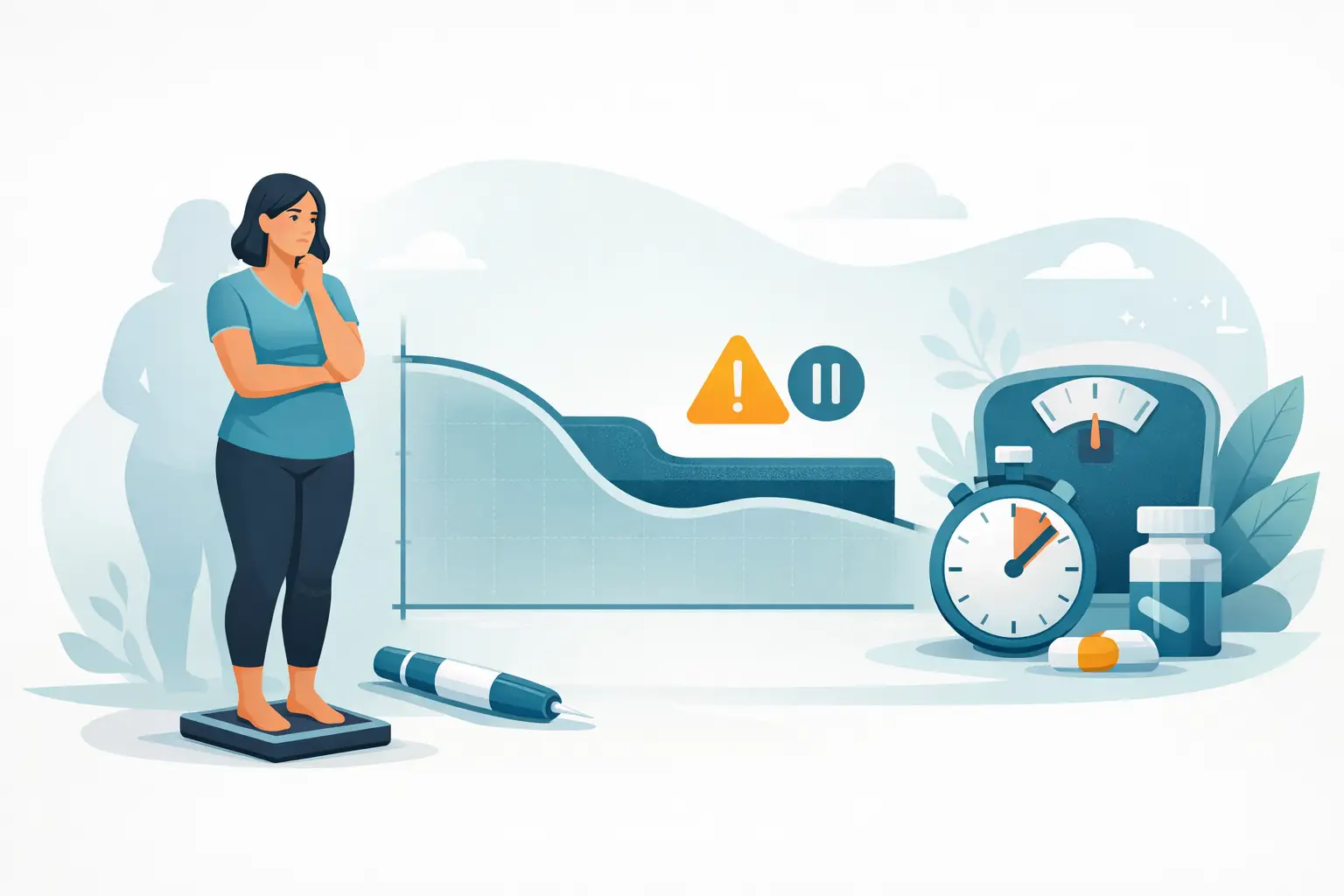
A patient loses 18 pounds in the first three months on tirzepatide, feels encouraged, then watches the scale sit in the same five-pound range for six weeks. That kind of weight loss plateau after tirzepatide example is common, frustrating, and not always a sign that the medication has stopped working. In many cases, it is a signal to look more closely at dose timing, protein intake, activity, sleep, hormones, bowel habits, and the broader metabolic picture.
A realistic weight loss plateau after tirzepatide example
Consider a 49-year-old woman in perimenopause with insulin resistance, central weight gain, poor sleep, and a long history of dieting. She starts tirzepatide under physician supervision, improves appetite control quickly, and begins eating less without feeling deprived. In the first 12 weeks, she loses weight steadily.
Then the pattern changes. Her weight drops two pounds, goes back up one, then stalls. She is still taking the medication, still eating less than before, and still trying to walk most days. At that point, many patients assume one of two things: either the drug has failed, or they personally have failed. Usually, neither is true.
What often happened is that the early phase of treatment corrected the easiest part of the problem – excess calorie intake driven by hunger, cravings, and poor satiety. After that, the slower contributors become more visible. Lower muscle mass, inconsistent protein intake, menopause-related hormonal shifts, constipation, reduced spontaneous movement, under-eating during the day followed by evening calories, and poor sleep can all blunt progress.
Why a plateau happens after early success
Tirzepatide can be very effective, but it does not override physiology. As body weight drops, energy needs also decline. The same intake that created a deficit at a higher weight may become closer to maintenance later on. That is normal biology, not proof that your metabolism is broken beyond repair.
There is also a behavioral side to plateaus. Some patients eat much less at first because nausea or strong appetite suppression makes it easy. Weeks later, side effects improve, routine slips, portions creep up, and liquid calories or convenience foods return. Others go too far in the opposite direction. They undereat protein, skip strength training, lose lean mass, and become more metabolically efficient in a way that slows further fat loss.
Hormones matter too. Midlife women often arrive with insulin resistance, sleep disruption, elevated stress load, and changing estrogen levels. Men may have low testosterone, sleep apnea, visceral fat, or untreated metabolic syndrome. In both groups, tirzepatide may help, but the medication works best when the underlying medical picture is being evaluated rather than guessed at.
What a plateau does and does not mean
A plateau does not automatically mean the dose is wrong. It does not automatically mean you need a different medication. It also does not automatically mean that food tracking has become inaccurate, although sometimes that is part of it.
A true plateau usually means body weight has remained essentially stable for several weeks despite good adherence. But even that needs context. If waist measurements are dropping, inflammation is improving, fasting glucose is better, and cravings are controlled, progress may still be happening. Scale weight is useful, but it is not the whole clinical story.
This is where physician-guided care matters. A rushed visit or a generic telehealth refill model may stop at, “Stay the course.” Real follow-up asks better questions. Are you actually at an effective dose for long enough to judge the response? Are side effects limiting adequate nutrition? Has constipation added several pounds of temporary scale weight? Has sleep deteriorated? Are thyroid function, insulin markers, liver enzymes, menopause symptoms, or testosterone status part of the picture?
How clinicians evaluate a tirzepatide plateau
When a patient reports stalled weight loss, the first step is not panic. It is pattern recognition.
A careful review usually starts with timing. How long has the plateau lasted? One or two flat weigh-ins are not a plateau. Four to eight weeks with little change is more meaningful. Next comes dose history. Some patients are still on an introductory dose and expect maintenance-level results. Others escalated too quickly, felt unwell, and have been eating in a nutritionally poor way that undermines body composition.
Nutrition review is rarely just about total calories. Protein matters. Fiber matters. Meal regularity matters. Hydration matters. Alcohol matters. If intake has become too low, especially in a patient already prone to muscle loss, the answer may not be to eat less. It may be to eat better and preserve lean mass.
Movement also needs a closer look. Not everyone needs intense exercise, but some form of resistance training is often important during GLP-1 and GIP-based treatment. Walking is valuable, especially for blood sugar control and recovery, but it may not be enough on its own if the goal is to maintain muscle and keep resting metabolic rate from falling further.
Then there are the medical variables. Thyroid dysfunction, sleep apnea, menopause-related changes, low testosterone, depression, certain medications, fluid retention, and chronic constipation can all mimic or worsen a plateau. This is why lab-informed care and continuity with the same physician can make a meaningful difference.
What adjustments may help
The right next step depends on why the plateau is happening. Sometimes the best move is dose optimization. Sometimes it is improving food quality and protein consistency. Sometimes it is addressing side effects so that the patient can eat in a more balanced way and move more comfortably.
For a patient in midlife, hormonal factors may need attention. If sleep is poor, hot flashes are frequent, and recovery is impaired, that is not separate from metabolic health. If a patient has signs of insulin resistance or fatty liver, those findings matter. If digestion has slowed significantly on treatment, gut-related symptoms may be affecting both comfort and adherence.
In practice, successful plateau management often looks less dramatic than patients expect. It may mean increasing protein at breakfast, adding two days of strength training, tightening weekend intake, improving hydration, managing constipation, reviewing labs, and reassessing dose strategy over the next month. Not flashy, but clinically sound.
When it is time to reassess the full plan
A prolonged plateau deserves a broader review if weight has been static for eight weeks or more, especially when the patient reports good adherence. That is the point where a physician should consider whether the issue is medication response, lifestyle mismatch, body composition change, or an untreated medical barrier.
This is also where patients benefit from having one doctor who knows the case over time. Fragmented care tends to miss patterns. A board-certified physician following your response longitudinally can see whether the trend suggests normal slowing, an avoidable obstacle, or the need for a different treatment strategy.
At Text2MD, that continuity is part of the model. The goal is not simply to prescribe a GLP-1 medication and hope for the best. It is to evaluate metabolism, hormones, symptoms, and follow-up data together so adjustments are based on medicine, not guesswork.
The bigger point behind any weight loss plateau after tirzepatide example
A plateau is often where superficial weight-loss programs stop being useful. Early results are easy to celebrate. The harder and more important phase is what happens when progress slows and the patient needs interpretation, not canned advice.
That is why the most effective care goes beyond the scale. Weight loss on tirzepatide is not just about appetite suppression. It is about preserving muscle, improving insulin sensitivity, managing side effects, watching labs, and identifying the reasons one person keeps progressing while another stalls.
If your progress has slowed, the right response is not to assume you are stuck forever. It is to get more precise. The plateau itself may be the moment that reveals what your metabolism has needed addressed all along.